Last updated: Feb 8th, 2026 (more conversation data, up from 2400 prompts on Jan 1st to 4887 prompts on Feb 8th)
Happy New Year everyone! I hope you all had a great holiday break, and also that 2026 is the year you get everything you want!
I think I’m a day late for these ‘year in review’ posts, but this was a fun little experiment so I’d like to share anyways. I spent my holiday downtime doing what any normal person would do: analyzing my conversations with Claude AI. (I was also grateful to be able to witness Victor Wembanyama’s awesomeness at the Spurs vs Knicks game in-person at San Antonio)
I’ve been using AI a LOT recently, even more than how much I was using over the past couple of years since OpenAI released ChatGPT. I’ve cycled through different models - proprietary, open-source, local-only and still keep experimenting as new tech is seemingly being shipped on a weekly basis, but for now, my daily driver especially for building has been Claude Code. So as I was looking through my mailbox last week, reading through all these “wrapped” emails about my activity with different products & services. I thought why not try out the same thing with these AI conversations and see what it reveals.
But what was the result of this analysis? A full summary of my prompting patterns, communication style, and AI usage habits. Think Spotify Wrapped, but for your conversations with AI. The results were super interesting!
What the data revealed?
After parsing through 4,887 prompts across Claude Code & Claude.ai, I discovered I’m what my tool classifies as a “Collaborator” - someone who asks questions politely and treats AI as a partner rather than a command-line interface. I hope the future AGI robots remember this!
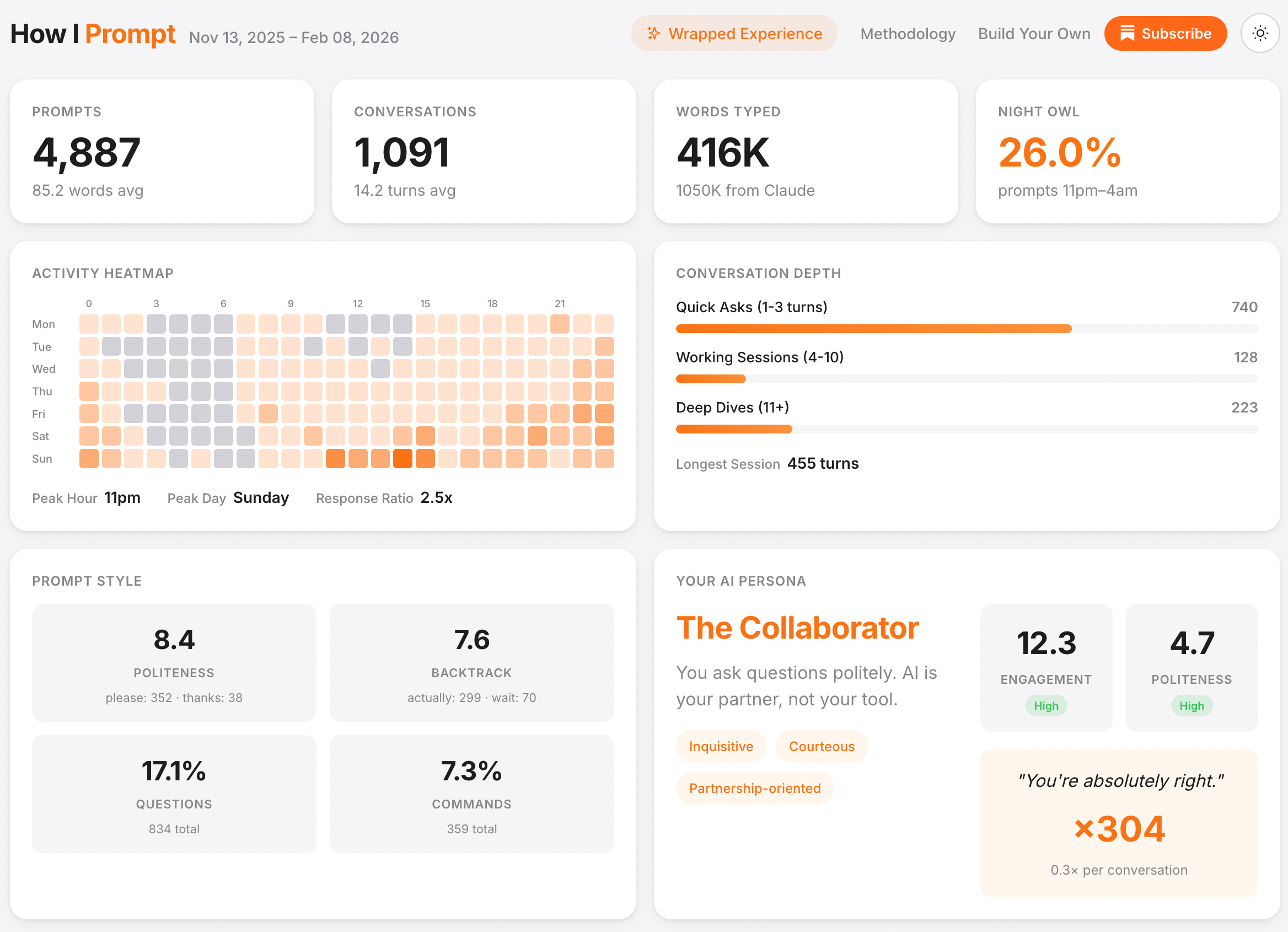
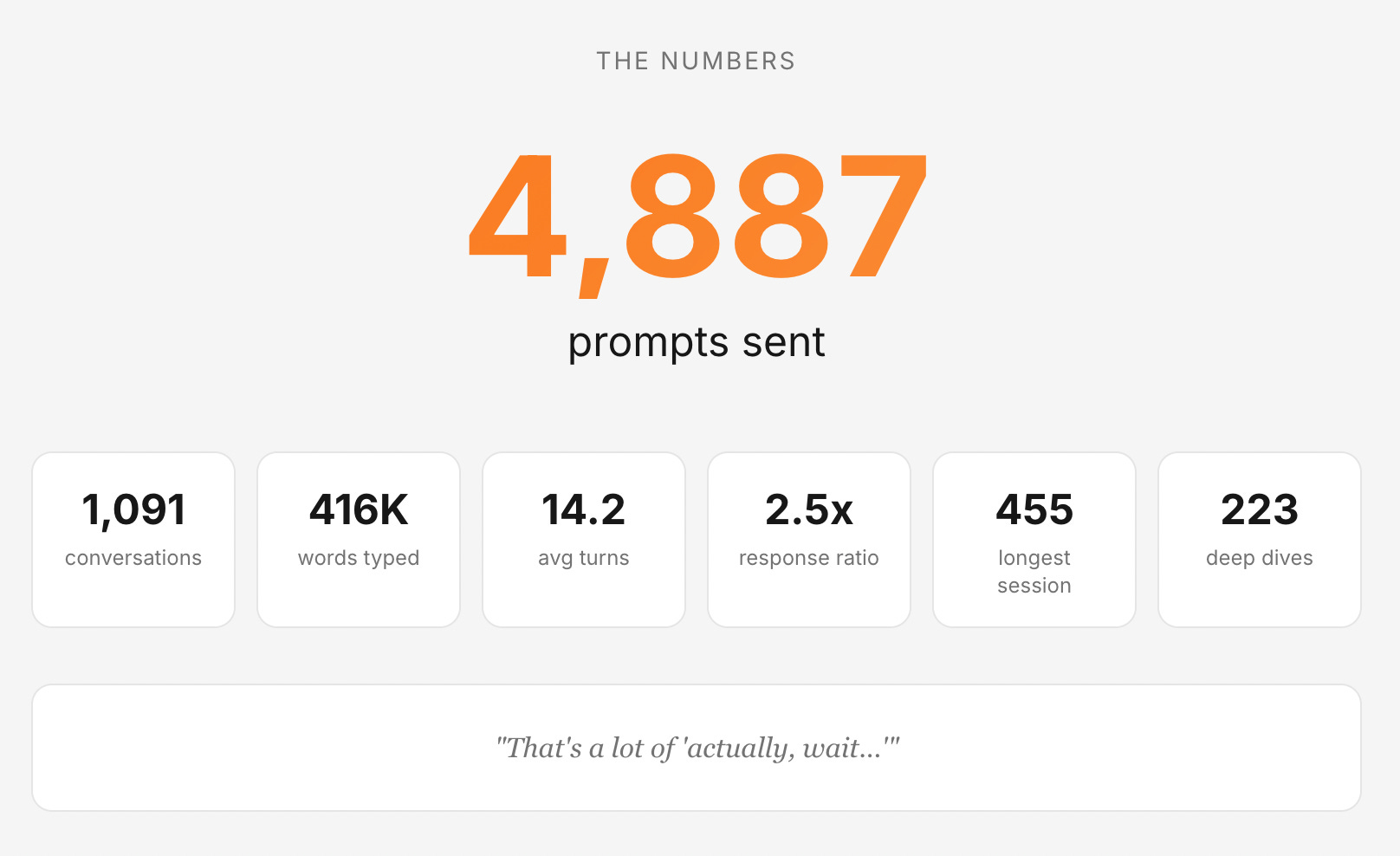
Some interesting highlights:
416K words typed into Claude
455 turns was my longest session (I hope it was worth it)
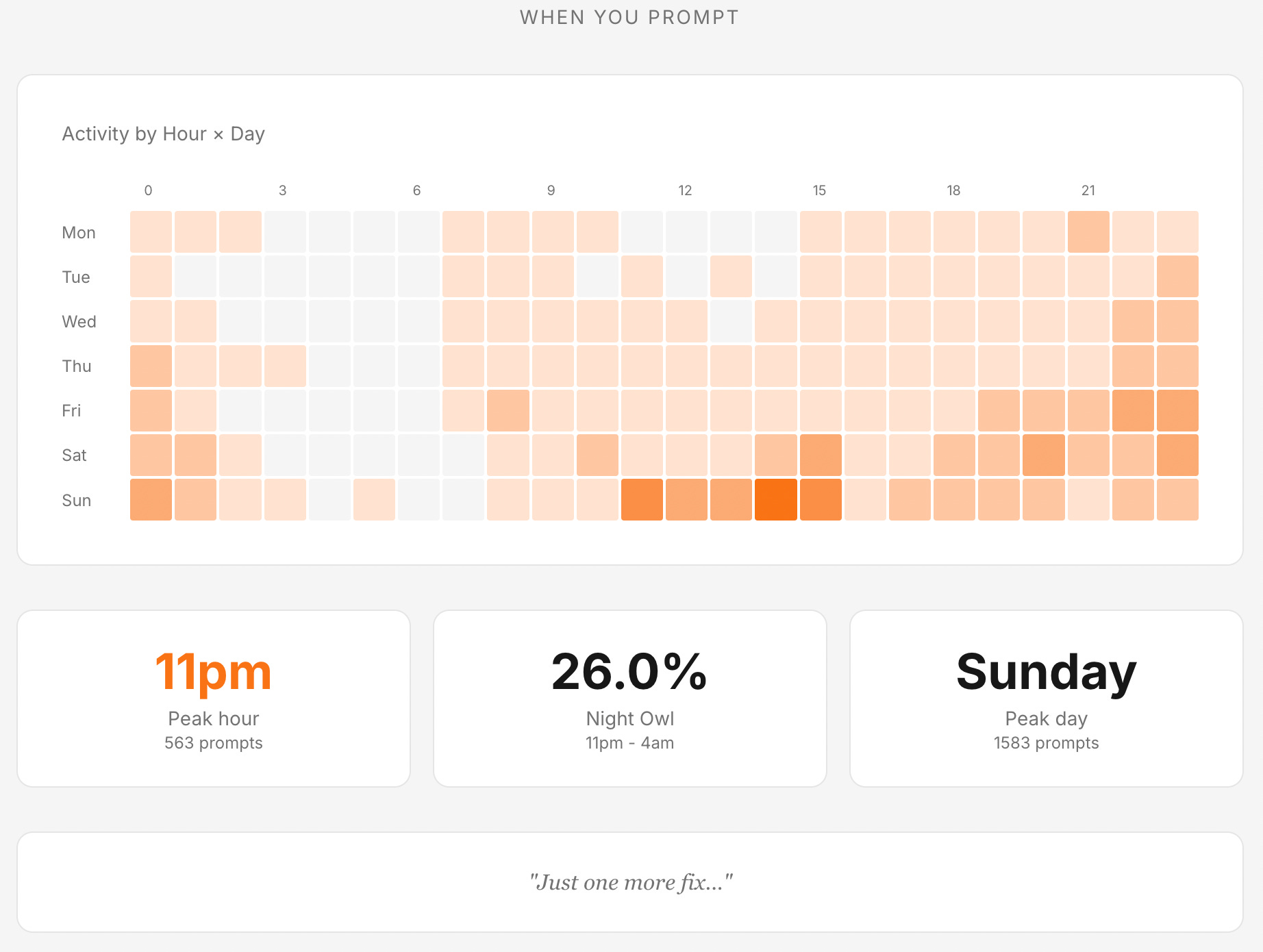
11 pm peak hour (did I say I do this after work?)
26% of my prompts were sent between 11 pm and 4 am (yes, way after work)
How it works?
I packaged this all up into a reusable tool with a simple HTML front-end and a single python script (Claude helped build this of course). The tool reads your local Claude conversation exports and computes everything client-side. No data leaves your machine. You get:
Volume stats (prompts, words, conversations)
Temporal patterns (activity heat-maps, peak hours)
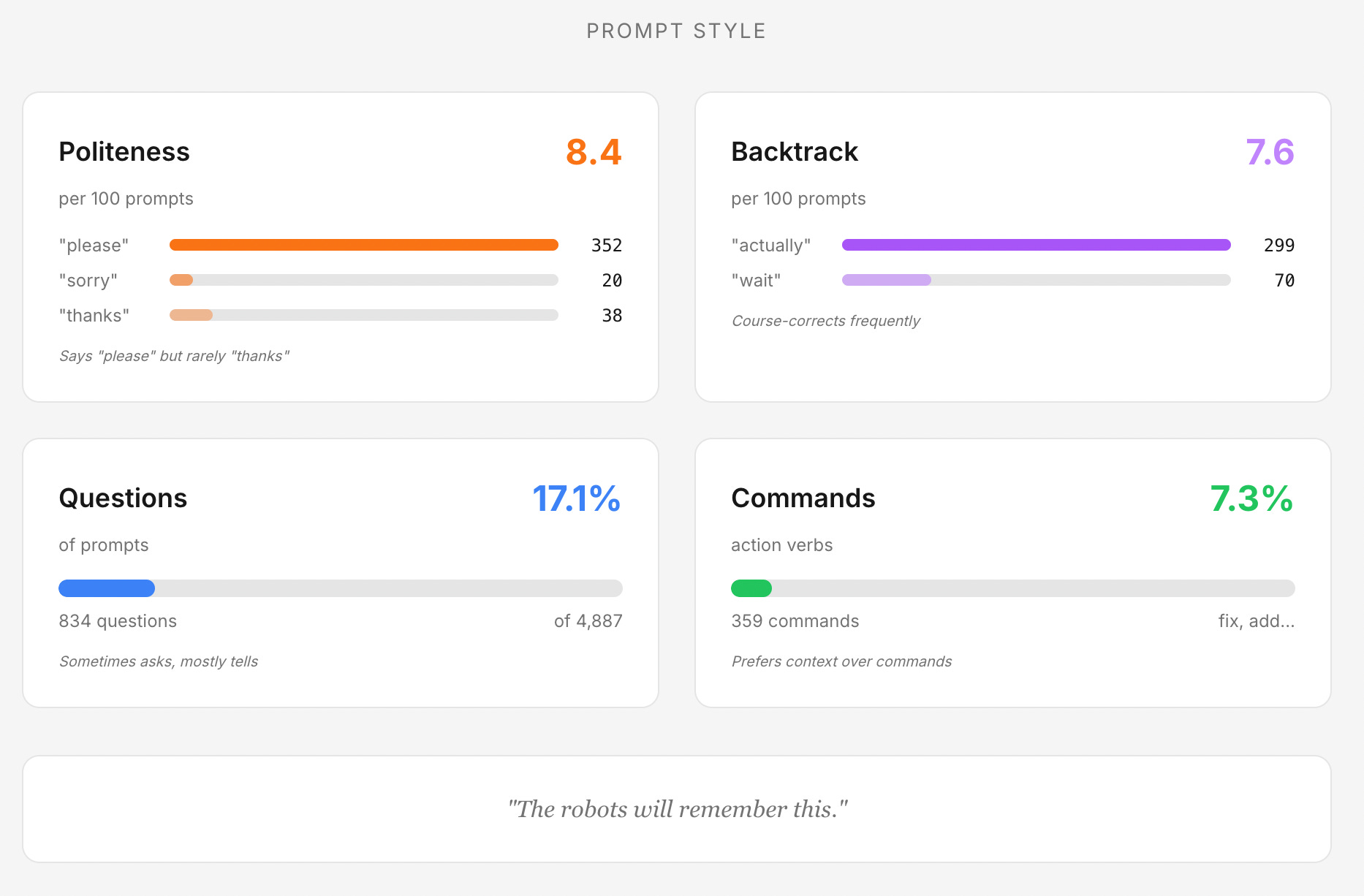
Communication style breakdown (politeness, questions, commands)
A persona classification based on your patterns
Feb 8th, 2026 Update: I now have a “Dashboard” view as the default, while still retaining the “Spotify Wrapped” experience as a separate wrapper.
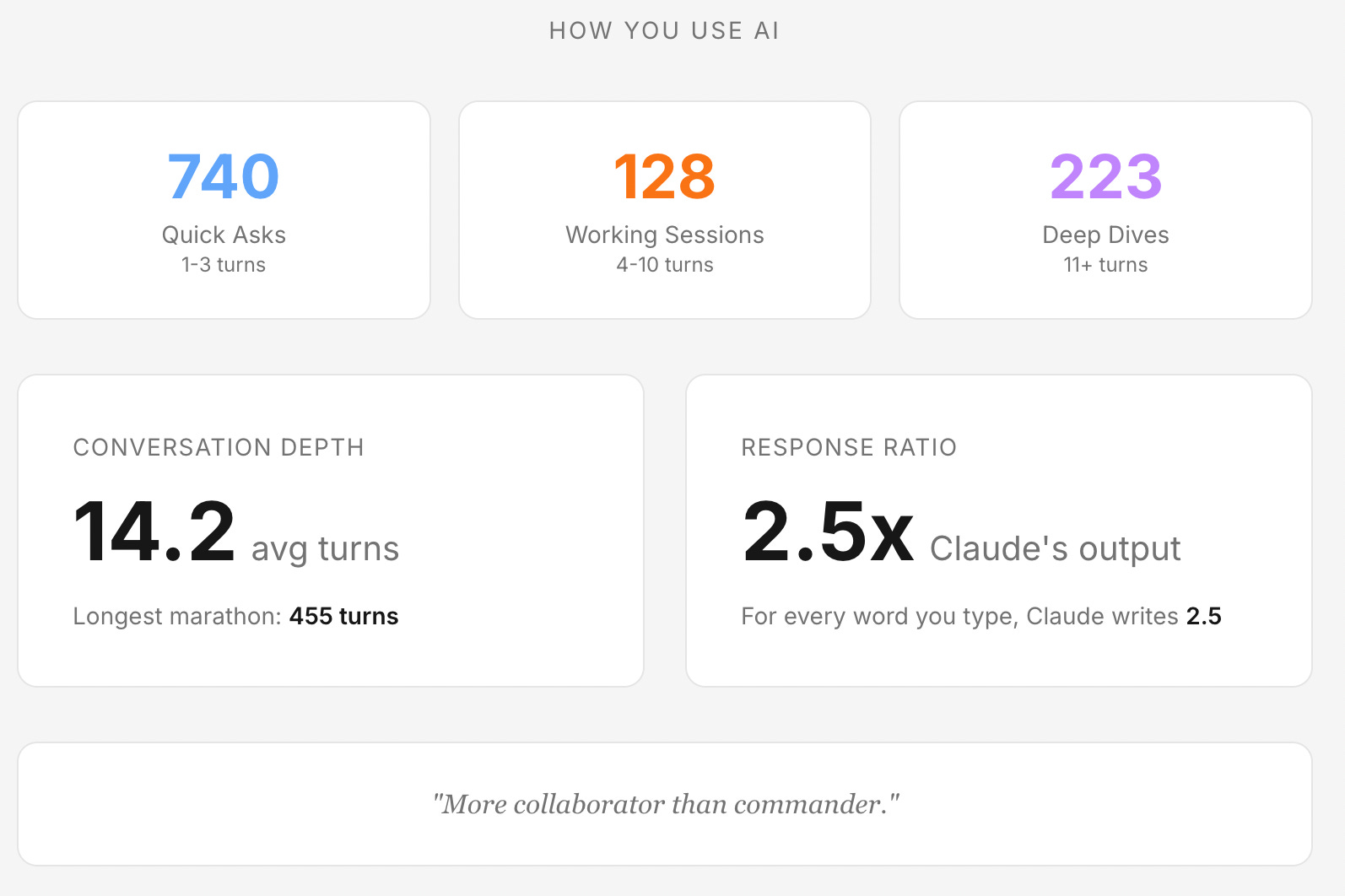
The 4 personas
The wrapped summary wouldn’t have been complete without a persona classification. With all the available metrics, I built a simple 2x2 matrix based on engagement and politeness scores:
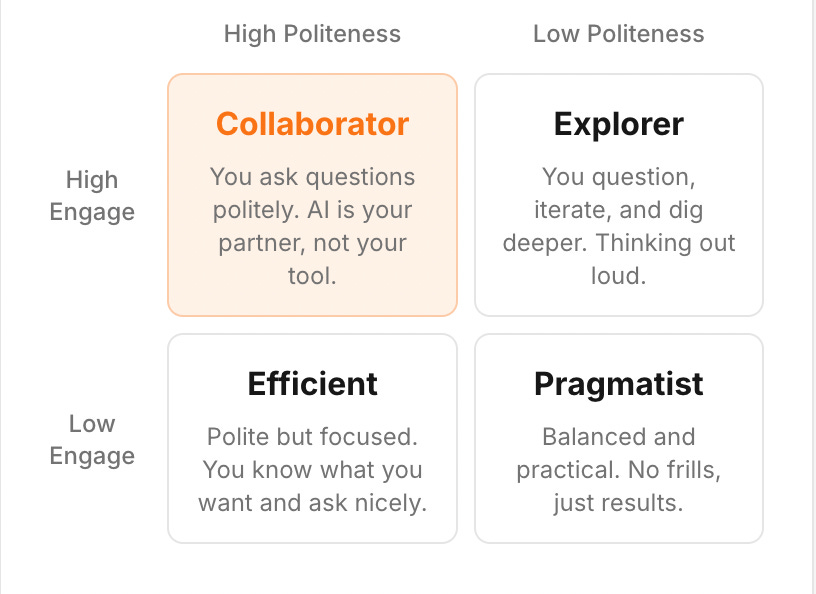
I don’t want to say that my little analysis competes with the the Big Five Personality Traits assessments, but I think looking at how you communicate with AI models, mostly in private, could reveal a lot about a person’s personality. I’m sure there are a TON of confounding factors that my analysis oversimplifies - version / provider of the model, external situation of the person (mental / physical stress), macro & micro environments etc. I’d love to hear from someone with a lot more expertise in psychology or linguistics on what they think about this.
Try it yourself
You can see my live page right here: howiprompt.eeshans.com. You can also click on the “Methodology” link to see full definitions of the metrics.
It’s open source, runs locally and takes about 2 minutes to set up → https://github.com/eeshansrivastava89/howiprompt. I’m sure this repo might have bugs since it’s just a fun little side-quest for me, so if you decide to try it out, then please let me know if you need any fixes / improvements. Also feel free to fork and make this concept into something larger. Would love to collaborate.
Fair warning: you might be surprised by what you find. I definitely didn’t expect to be a night owl who says “please” more than “thanks”.
What’s your prompting style? I’d love to see other people’s results.